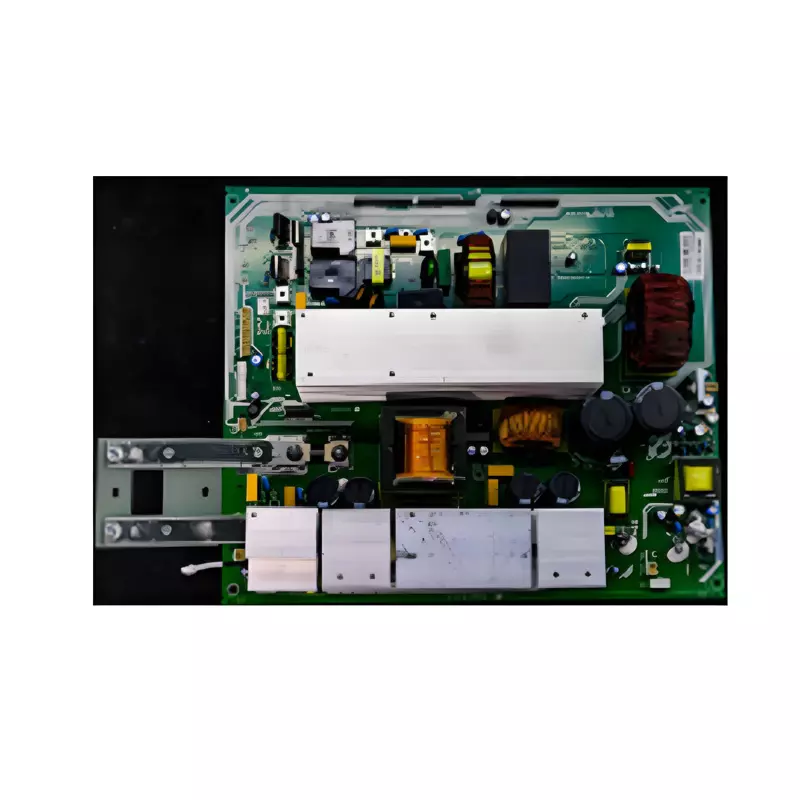
Photovoltaic Inverter PCBA – Product Overview
Overview
The photovoltaic inverter PCBA (Printed Circuit Board Assembly) is the intelligent core engine of a solar power generation system. Designed to efficiently and stably convert the DC power generated by solar panels into AC power for direct use in homes and businesses, it is a critical component in unlocking the potential of solar energy. As the "intelligent heart" of a solar system, the inverter PCBA carries the core responsibility for energy conversion.
Core Functionality
A solar inverter PCBA serves as the high-speed switching hub of a power electronics system. At its center is a power stage arranged in a Full-Bridge or Three-Phase Bridge topology, comprised of high-performance semiconductor switches such as MOSFETs, IGBTs, or Silicon Carbide (SiC) devices.
The PCBA's controller (MCU or DSP) executes high-frequency Pulse Width Modulation (PWM), toggling the semiconductor switches on and off at frequencies ranging from 20 kHz to over 100 kHz. Through this switching and filtering process, DC input from solar panels is converted into a stable AC output with controlled voltage and frequency.
Key subsystems integrated into the PCBA include:
-
DC input interface and EMI filter module
-
DC-DC boost converter
-
DC-AC inverter bridge
-
MPPT (Maximum Power Point Tracking) control module
-
Gate drive circuit
-
Voltage/current sensing network
-
DSP/Microcontroller core
-
AC output filter module
Key Technical Features
1. High-Power Capacity
Photovoltaic inverter PCBAs are designed to high power ranging from 3kW to 30kW for residential applications, and 50kW+ for commercial and industrial systems. Current loads can reach tens to hundreds of amperes.
2. Thick Copper & Aluminum Substrate for Thermal Management
To carry large currents safely and manage heat dissipation, inverter PCBAs utilize thick-copper construction (typically 2–4 oz, and can go up to 10–14 oz in extreme cases) or aluminum substrates. Aluminum substrates (thermal conductivity 1–3 W/m·K) effectively reduce component temperatures. Thermal vias (filled with thermal conductive paste) are used in conjunction with heat sinks.
3. High-Voltage Isolation & Creepage Clearance
PV systems operate at DC voltages up to 1500V-. The PCBA must meet stringent insulation requirements: electrical clearance ≥5 mm (reinforced insulation), creepage distance ≥8 mm (material group IIIa), and must pass Hi-Pot testing at 2500–5000V AC/1 minute without breakdown.
4. MPPT Precision Circuitry
Maximum Power Point Tracking requires high-precision ADCs (16–24 bit) and operational amplifiers. Voltage/current sampling circuits use high-precision components (±1%) with low-noise PCB design (analog/digital separation).
5. Wide Temperature Range & Environmental Durability
Inverters must operate reliably in harsh outdoor environments ranging from -40°C to +85°C. The PCBA undergoes conformal coating (moisture, fungus, and salt spray protection), uses high-Tg substrates (Tg ≥150–170°C), and passes temperature cycling tests (500 cycles without cracks).
6. Strong & Weak Current Segregation
Inverter PCBA designs feature segregation between high-power and low-signal sections to minimize electromagnetic interference and ensure signal integrity.
7. High-Density Layout & Power Density
Modern solar inverter circuit boards achieve power densities exceeding 1W/cm³, necessitating multi-layer PCB technology (typically 6–8 layers). Power loops adopt a "laminated busbar" structure to reduce parasitic inductance below 20nH.
Manufacturing Capabilities
Yaxingda provides comprehensive PCBA manufacturing services for photovoltaic inverters, including:
Key manufacturing requirements for inverter PCBAs:
-
Aluminum substrate or thick copper board (2–4 oz) capability
-
High-precision MPPT circuit assembly (16–24 bit ADC + ±1% resistors)
-
High-voltage isolation design (creepage ≥8–20 mm)
-
Conformal coating (automated spray)
-
Hi-Pot testing (3000–5000V AC)
-
IATF 16949 / ISO9001 certified quality management
Applications
The photovoltaic inverter PCBA is widely used across multiple scenarios:
-
Residential Rooftop Solar Systems: Perfectly compatible with all types of home solar installations, providing clean and economical electricity for families
-
Commercial & Industrial Solar: Meeting the needs of factories, shopping malls, and office buildings for efficient and reliable solar power generation
-
Off-Grid Systems: Providing stable AC power for remote areas, communication base stations, and outdoor facilities
-
Energy Storage Systems: Supporting grid connection and battery integration for hybrid energy solutions
-
New & Existing System Upgrades: Seamless integration for new solar plants or upgrades to existing systems
Why Choose Yaxingda for Inverter PCBA?
-
20 years of PCBA EMS manufacturing experience
-
ISO9001 and IATF 16949 certified
-
20 SMT lines with 40M+ points/day capacity
-
24,000㎡ manufacturing facility with 1,000+ employees
-
Full MES and ERP digitalized process control
-
End‑to‑end supply chain: from component sourcing to final delivery
-
Proven experience serving world‑leading photovoltaic inverter manufacturers